Geography (from Ancient Greekγεωγραφίαgeōgraphía; combining gê 'Earth' and gráphō 'write', literally 'Earth writing') is the study of the lands, features, inhabitants, and phenomena of Earth. Geography is an all-encompassing discipline that seeks an understanding of Earth and its human and natural complexities—not merely where objects are, but also how they have changed and come to be. While geography is specific to Earth, many concepts can be applied more broadly to other celestial bodies in the field of planetary science. Geography has been called "a bridge between natural science and social science disciplines."
The history of geography as a discipline spans cultures and millennia, being independently developed by multiple groups, and cross-pollinated by trade between these groups. Geography as a discipline dates back to the earliest attempts to understand the world spatially, with the earliest example of an attempted world map dating to the 9th century BC in ancient Babylon. Origins of many of the concepts in geography can be traced to Greek Eratosthenes of Cyrene, who may have coined the term "geographia" (c. 276 BC – c. 195/194 BC). The first recorded use of the word γεωγραφία was as the title of a book by Greek scholar Claudius Ptolemy (100 – 170 AD). During the Middle Ages, geography was influenced by Islamic scholars, such as Muhammad al-Idrisi, producing detailed maps of the world. The Age of Discovery was influential in the development of geography, as European explorers mapped the New World. Modern developments include the development of geomatics and geographic information science.
The core concepts of geography consistent across all approaches are a focus on space, place, time, and scale. Today, geography is an extremely broad discipline with multiple approaches and modalities. The main branches of geography are physical geography, human geography, and technical geography. Physical geography focuses on the natural environment, human geography focuses on how humans interact with the Earth, and technical geography focuses on the development of tools for understanding geography. Techniques employed can generally be broken down into quantitative and qualitative approaches, with many studies taking mixed-methods approaches. Common techniques include cartography, remote sensing, interviews, and surveying. (Full article...)
The Kennet and Avon Canal is a waterway in southern England with an overall length of 87 miles (140 km), made up of two lengths of navigable river linked by a canal. The name is used to refer to the entire length of the navigation rather than solely to the central canal section. From Bristol to Bath the waterway follows the natural course of the River Avon before the canal links it to the River Kennet at Newbury, and from there to Reading on the River Thames. In all, the waterway incorporates 105 locks.
The two river stretches were made navigable in the early 18th century, and the 57-mile (92 km) canal section was constructed between 1794 and 1810. In the late 19th and early 20th centuries, the canal gradually fell into disuse after the opening of the Great Western Railway. In the latter half of the 20th century the canal was restored in stages, largely by volunteers. After decades of dereliction and much restoration work, it was fully reopened in 1990. The Kennet and Avon Canal has been developed as a popular heritage tourism destination for boating, canoeing, fishing, walking and cycling, and is also important for wildlife conservation. (Full article...)
A large eruption took place approximately 2,600 years ago. Guallatiri has been active in historical times with a number of eruptions, the latest in 1960. Fumarolic and seismic activity is ongoing and has resulted in the deposition of sulfur and other minerals on the volcano. The volcano is covered by an ice cap above 5,500 to 5,800 m (18,000 to 19,000 ft) that has shrunk and fragmented during the course of the 20th and 21st centuries. Guallatiri, along with several other volcanoes, is part of Lauca National Park and is monitored by the Chilean National Geology and Mining Service (SERNAGEOMIN). (Full article...)
A satellite image of the lower Florida peninsula showing darkened portions south of Lake Okeechobee as the Everglades and Big Cypress Swamp. The reddish area bordering the large inland lake is the Everglades Agricultural Area. Before drainage, the Everglades, a region of tropicalwetlands in southern Florida, were an interwoven mesh of marshes and prairies covering 4,000 square miles (10,000 km2). The Everglades is both a vast watershed that has historically extended from Lake Okeechobee 100 miles (160 km) south to Florida Bay (around one-third of the southern Florida peninsula), and many interconnected ecosystems within a geographic boundary. It is such a unique meeting of water, land, and climate that the use of either singular or plural to refer to the Everglades is appropriate. When Marjory Stoneman Douglas wrote her definitive description of the region in 1947, she used the metaphor "River of Grass" to explain the blending of water and plant life.
Although sawgrass and sloughs are the enduring geographical icons of the Everglades, other ecosystems are just as vital, and the borders marking them are subtle or nonexistent. Pinelands and tropical hardwood hammocks are located throughout the sloughs; the trees, rooted in soil inches above the peat, marl, or water, support a variety of wildlife. The oldest and tallest trees are cypresses, whose roots are specially adapted to grow underwater for months at a time. The Big Cypress Swamp is well known for its 500-year-old cypresses, though cypress domes can appear throughout the Everglades. As the freshwater from Lake Okeechobee makes its way to Florida Bay, it meets saltwater from the Gulf of Mexico; mangrove forests grow in this transitional zone, providing nursery and nesting conditions for many species of birds, fish, and invertebrates. The marine environment of Florida Bay is also considered part of the Everglades because its seagrasses and aquatic life are attracted to the constant discharge of freshwater. (Full article...)
Image 5
Columbia Slough near its mouth
The Columbia Slough is a narrow waterway, about 19 miles (31 km) long, in the floodplain of the Columbia River in the U.S. state of Oregon. From its source in the Portland suburb of Fairview, the Columbia Slough meanders west through Gresham and Portland to the Willamette River, about 1 mile (1.6 km) from the Willamette's confluence with the Columbia. It is a remnant of the historic wetlands between the mouths of the Sandy River to the east and the Willamette River to the west. Levees surround much of the main slough as well as many side sloughs, detached sloughs, and nearby lakes. Drainage district employees control water flows with pumps and floodgates. Tidal fluctuations cause reverse flow on the lower slough.
The Columbia floodplain, formed by geologic processes including lava flows, volcanic eruptions, and the Missoula Floods, is part of the Portland Basin, which extends across the Columbia River from Multnomah County, Oregon, into Clark County, Washington. Five percent of Oregon's population, about 158,000 people, live in the slough watershed of about 51 square miles (130 km2). Municipal wells near the upper slough provide supplemental drinking water to Portland and nearby cities. The cities, the drainage districts, the county, and a regional government, Metro, have overlapping jurisdictions in the watershed. A regional agency operates Portland International Airport along the middle slough and marine terminals near the lower slough. The Oregon Department of Environmental Quality (DEQ) and the city's Bureau of Environmental Services (BES) deal with environmental issues. (Full article...)
It is unclear if there was a formally established constitution dictating the laws, organization, and divisions of power in ancient Macedonia's government, although some tangential evidence suggests this. The king (basileus) served as the head of state and was assisted by his noble companions and royal pages. Kings served as the chief judges of the kingdom, although little is known about Macedonia's judiciary. The kings were also expected to serve as high priests of the nation, using their wealth to sponsor various religious cults. The Macedonian kings had command over certain natural resources such as gold from mining and timber from logging. The right to mint gold, silver, and bronze coins was shared by the central and local governments. (Full article...)
Tumbler Ridge is a planned community, with the housing and infrastructure built simultaneously in 1981 by the provincial government to service the coal industry as part of the British Columbia Resources Investment Corporation's Northeast Coal Development. In 1981, a consortium of Japanese steel mills agreed to purchase 100 million tonnes of coal over 15 years for US$7.5 billion from two mining companies, Denison Mines Inc. and the Teck Corporation, who were to operate the Quintette mine and the Bullmoose mine respectively. The uncertainty dissuaded investment and kept the economy from diversifying. When price reductions were forced onto the mines, the Quintette mine was closed in 2000 production and the town lost about half its population. Coal prices began to rise after the turn of the century, leading to the opening of the Peace River Coal Trend mine by Northern Energy & Mining Inc. (now owned by Anglo American Met Coal) and the Wolverine Mine, originally owned by Western Canadian Coal, which was purchased by Walter Energy in 2010. Walter went bankrupt in 2015, and their Canadian assets—including the Wolverine Mine—were purchased by Conuma Coal in 2016. (Full article...)
Image 8
Satellite image of Cerro Blanco volcano. The black area on the upper edge is Carachipampa volcano. Cerro Blanco caldera is located slightly left and below the centre of the image and is the grey-yellow area. Top of image is to the north-northeast.
Cerro Blanco (Spanish:[ˈseroˈβlaŋko], "White Hill") is a caldera in the Andes of the Catamarca Province in Argentina. Part of the Central Volcanic Zone of the Andes, it is a volcano collapse structure located at an altitude of 4,670 metres (15,320 ft) in a depression. The caldera is associated with a less well-defined caldera to the south and several lava domes.
The caldera has been active for the last eight million years, and eruptions have created several ignimbrites. An eruption occurred 73,000 years ago and formed the Campo de la Piedra Pómez ignimbrite layer. About 2,300 ± 160 BCE, the largest known volcanic eruption of the Central Andes, with a VEI-7, occurred at Cerro Blanco, forming the most recent caldera as well as thick ignimbrite layers. About 170 cubic kilometres (41 cu mi) of tephra were erupted then. The volcano has been dormant since then with some deformation and geothermal activity. A major future eruption would put nearby communities to the south at risk. (Full article...)
Gregor MacGregor (24 December 1786 – 4 December 1845) was a Scottish soldier, adventurer, and con man who attempted from 1821 to 1837 to draw British and French investors and settlers to "Poyais", a fictional Central American territory that he claimed to rule as "Cazique". Hundreds invested their savings in supposed Poyaisian government bonds and land certificates, while about 250 emigrated to MacGregor's invented country in 1822–23 to find only an untouched jungle; more than half of them died. MacGregor's Poyais scheme has been called one of the most brazen confidence tricks in history.
From the Clan Gregor, MacGregor was an officer in the British Army from 1803 to 1810; he served in the Peninsular War. He joined the republican side in the Venezuelan War of Independence in 1812, quickly became a general and, over the next four years, operated against the Spanish on behalf of both Venezuela and its neighbour New Granada. His successes included a difficult month-long fighting retreat through northern Venezuela in 1816. He captured Amelia Island in 1817 under a mandate from revolutionary agents to conquer Spanish Florida, and there proclaimed a short-lived "Republic of the Floridas". He then oversaw two calamitous operations in New Granada during 1819 that each ended with his abandoning British volunteer troops under his command. (Full article...)
Suillus bovinus produces spore-bearing fruit bodies, often in large numbers, above ground. The mushroom has a convex grey-yellow or ochre cap reaching up to 10 cm (4 in) in diameter, which flattens with age. Like other boletes, it has tubes extending downward from the underside of the cap, rather than gills; spores escape at maturity through the tube openings, or pores. The pore surface is yellow. The stipe, more slender than those of other Suillus boletes, lacks a ring. (Full article...)
Image 11
Cannon decorate the quayside of Balfour Harbour on Shapinsay, the round tower in the background is The Douche
Shapinsay (/ˈʃæpɪnziː/, Scots: Shapinsee) is one of the Orkney Islands off the north coast of mainland Scotland. With an area of 29.5 square kilometres (11.4 sq mi), it is the eighth largest island in the Orkney archipelago. It is low-lying and, with a bedrock formed from Old Red Sandstone overlain by boulder clay, fertile, causing most of the area to be used for farming. Shapinsay has two nature reserves and is notable for its bird life. Balfour Castle, built in the Scottish Baronial style, is one of the island's most prominent features, a reminder of the Balfour family's domination of Shapinsay during the 18th and 19th centuries; the Balfours transformed life on the island by introducing new agricultural techniques. Other landmarks include a standing stone, an Iron Agebroch, a souterrain and a salt-water shower.
There is one village on the island, Balfour, from which roll-on/roll-off car ferries sail to Kirkwall on the Orkney Mainland. At the 2011 census, Shapinsay had a population of 307. The economy of the island is primarily based on agriculture with the exception of a few small businesses that are largely tourism-related. A community-owned wind turbine was constructed in 2011. The island has a primary school but, in part due to improving transport links with mainland Orkney, no longer has a secondary school. Shapinsay's long history has given rise to various folk tales. (Full article...)
Image 12
Map of Lajjun Sanjak, the territory governed by the Turabay dynasty for most of the 16th and 17th centuries
During the conquest of the Levant and Egypt by the Ottoman Empire in 1516–1517, the Turabay chief Qaraja and his son Turabay aided the forces of Ottoman Sultan Selim I. The Ottomans kept them in their Mamluk-era role as guardians of the strategic Via Maris and Damascus–Jerusalem highways and rewarded them with tax farms in northern Palestine. Their territory became a sanjak in 1559 and Turabay's son Ali became its first governor. His brother Assaf was appointed in 1573, serving for ten years before being dismissed and exiled to Rhodes for involvement in a rebellion. His nephew Turabay was appointed in 1589 and remained in office until his death in 1601. His son and successor Ahmad, the most prominent chief of the dynasty, ruled Lajjun for nearly a half-century and repulsed attempts by the powerful Druze chief and Ottoman governor of Sidon-Beirut and Safed, Fakhr al-Din Ma'n, to take over Lajjun and Nablus in the 1620s. He consolidated the family's alliance with the Ridwan and Farrukh governing dynasties of Gaza and Nablus, which remained intact until the dynasties' demise toward the end of the century. (Full article...)
The town lies close to the route of the ancient Watling Street, and although there is no record of its existence before the 17th century, Ogley Hay – a district of the town today – is recorded as a settlement in the Domesday Book. Brownhills quickly grew around the coal-mining industry, especially after the town became linked to the canal and railway networks in the mid-19th century. By the end of the century, Brownhills had grown from a hamlet of only 300 inhabitants to a town of more than 13,000, of whom the vast majority were employed in the coal industry. Mining remained the town's principal industry until the 1950s; the subsequent closure of the pits led to a severe economic decline that has continued until now. The local authority instituted a regeneration programme in 2007, which was hoped would revive the town's fortunes, but there has been little subsequent development. (Full article...)
Image 14
Bryce Canyon National Park (/braɪs/) is a national park of the United States located in southwestern Utah. The major feature of the park is Bryce Canyon, which, despite its name, is not a canyon but a collection of giant natural amphitheaters along the eastern side of the Paunsaugunt Plateau. Bryce is distinctive due to geological structures called hoodoos, formed by frost weathering and stream erosion of the river and lake bed sedimentary rock. The red, orange, and white colors of the rocks provide distinctive views for park visitors. Bryce Canyon National Park is much smaller and sits at a much higher elevation than nearby Zion National Park. The rim at Bryce varies from 8,000 to 9,000 feet (2,400 to 2,700 m).
The area is in portions of Garfield County and Kane County. It was settled by Mormon pioneers in the 1850s and was named after Ebenezer Bryce, who homesteaded in the area in 1874. The area was originally designated as a national monument by President Warren G. Harding in 1923 and was redesignated as a national park by Congress in 1928. The park covers 35,835 acres (55.992 sq mi; 14,502 ha; 145.02 km2) and receives substantially fewer visitors than Zion National Park (nearly 4.3 million in 2016) or Grand Canyon National Park (almost 6 million in 2016), largely due to Bryce's more remote location. In 2024, Bryce Canyon received almost 2.5million visitors. (Full article...)
Image 15
Yellow iron oxide-covered lava rock on the flank of Kamaʻehuakanaloa
Kamaʻehuakanaloa Seamount (previously known as Lōʻihi) is an active submarine volcano about 22 mi (35 km) off the southeast coast of the island of Hawaii. The top of the seamount is about 3,200 ft (975 m) below sea level. This seamount is on the flank of Mauna Loa, the largest subaerial active shield volcano on Earth. Kamaʻehuakanaloa is the newest volcano in the Hawaiian–Emperor seamount chain, a string of volcanoes that stretches about 3,900 mi (6,200 km) northwest of Kamaʻehuakanaloa. Unlike most active volcanoes in the Pacific Ocean that make up the active plate margins on the Pacific Ring of Fire, Kamaʻehuakanaloa and the other volcanoes of the Hawaiian–Emperor seamount chain are hotspot volcanoes and formed well away from the nearest plate boundary. Volcanoes in the Hawaiian Islands arise from the Hawaii hotspot, and as the youngest volcano in the chain, Kamaʻehuakanaloa is the only Hawaiian volcano in the deep submarine preshield stage of development.
Kamaʻehuakanaloa began forming around 400,000 years ago and is expected to begin emerging above sea level about 10,000–100,000 years from now. At its summit, Kamaʻehuakanaloa Seamount stands more than 10,000 ft (3,000 m) above the seafloor, making it taller than Mount St. Helens was before its catastrophic 1980 eruption. A diverse microbial community resides around Kamaʻehuakanaloa's many hydrothermal vents. (Full article...)
The Yukon Delta is a river delta formed by the Yukon River as it drains into the Bering Sea. It is part of the larger Yukon–Kuskokwim Delta, which includes the delta of the Kuskokwim River. The Yukon River rises in British Columbia, Canada, and flows through Yukon before entering the U.S. state of Alaska. This August 2017 satellite image of the Yukon Delta shows how the river branches into numerous distributary channels that meander through the low-lying terrain on their way to the sea. The sandy colour of these channels and the coastal water is indicative of the marine sediment the river carries to the sea at this time of year.
A world map entitled Nova totius terrarum orbis tabula Amstelodami, created in 1689 by Gerard van Schagen. This map, created in Amsterdam, measures 48.3 by 56.0 centimetres (19.0 by 22.0 in) in size and was made using copper engraving.
Photo: Jeff Schmaltz, MODIS Rapid Response Team, NASA
A satellite photo of Great Britain and part of Ireland showing the extent of snow cover during the winter of 2009–2010, the coldest in Europe since 1981–82. Starting on 16 December 2009 a persistent weather pattern brought cold moist air from the north with systems undergoing cyclogenesis from North American storms moving across the Atlantic Ocean to the west, and saw many parts of Europe experiencing heavy snowfall and record low temperatures.
Author: John Mitchell; scan: Library of Congress, Geography and Map Division.
The Mitchell Map is the most comprehensive map of eastern North America made during the colonial era. Measuring about 6.5 ft (2.0 m) wide by 4.5 ft (1.4 m) high, it was produced by John Mitchell in 1757 in eight separate sheets. The map was used during the Treaty of Paris for defining the boundaries of the United States, and remains important today for resolving border disputes.
The General Perspective projection is a map projection used in cartography in which the Earth is depicted as viewed from a finite distance above its surface. If the view precisely faces the center of the Earth, the projection is a vertical perspective projection; otherwise, it is a tilted perspective projection. Here is shown a vertical perspective from an altitude of 35,786 km over (0°, 90°W), corresponding to a view from geostationary orbit. Due to the horizon as seen from the viewpoint position, the projection always shows less than half of the Earth's surface: in this case neither of the North and South Poles is visible.
The Lambert conformal conic projection is a conic map projection used for aeronautical charts, portions of the State Plane Coordinate System, and many national and regional mapping systems. It is one of seven projections introduced by Johann Heinrich Lambert in 1772. Conceptually, the projection seats a cone over the sphere of the Earth and projects the surface conformally onto the cone. The cone is unrolled, and the parallel that was touching the sphere is assigned unit scale. By scaling the resulting map, two parallels can be assigned unit scale, with scale decreasing between them and increasing outside them. Unlike other conic projections, no true secant form of this projection exists.
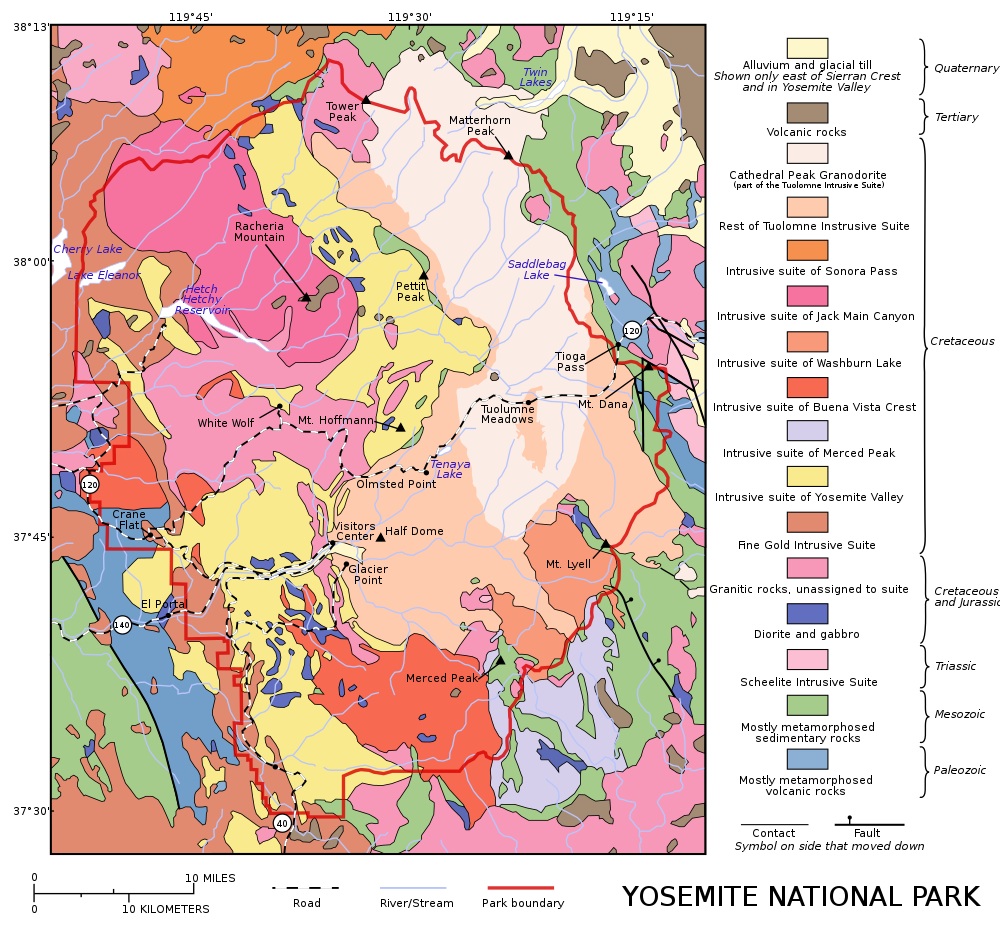
A geological map of Yosemite National Park (full size), showing the Cathedral Peak Granodiorite, the largest unit in the Tuolumne Intrusive Suite, which in turn is the largest granitic suite in the park. Cathedral Peak Granodiorite Rest of the Tuolumne Intrusive Suite
The equirectangular projection is a simple map projection attributed to Marinus of Tyre, who Ptolemy claims invented the projection about AD 100. The projection maps meridians to vertical straight lines of constant spacing, and circles of latitude to horizontal straight lines of constant spacing. The projection is neither equal area nor conformal. Because of the distortions introduced by this projection, it has few applications beyond base imagery to be reprojected to some more useful projection.
Photograph: Maull & Fox; restoration: Adam Cuerden
Fanny Bullock Workman (1859–1925) was an American geographer, cartographer, explorer, travel writer, and mountaineer. Together with her husband, William Hunter Workman, she traveled by bicycle through Switzerland, France, Italy, Spain, Algeria and India; after taking up climbing in the Himalayas, she set a women's altitude record on Pinnacle Peak, reaching 23,000 feet (7,000 m). She published eight travel books, with particular focus on the lives of women in the countries she visited, and championed women's rights and women's suffrage.
A c. 1650 map showing the Island of California, a long-held European misconception, dating from the 16th century, that California was not part of mainland North America but rather a large island separated from the continent by a strait now known instead as the Gulf of California. The belief persisted until the expeditions of Juan Bautista de Anza in 1774–76.
He led the team that made the first crossing of the Greenland interior in 1888, traversing the island on cross-country skis. He won international fame after reaching a record northern latitude of 86°14′ during his Fram expedition of 1893–1896. Although he retired from exploration after his return to Norway, his techniques of polar travel and his innovations in equipment and clothing influenced a generation of subsequent Arctic and Antarctic expeditions. He was elected an International Member of the American Philosophical Society in 1897. (Full article...)
Generation Z, often shortened to Gen Z and informally known as Zoomers, is the demographic cohort succeeding Millennials and preceding Generation Alpha. Researchers and popular media use the mid-to-late 1990s as starting birth years and the early 2010s as ending birth years, with the generation typically being defined as people born from 1997 to 2012. Most members of Generation Z are the children of members of Generation X, and it is predicted that many will be the parents of Generation Beta. (Full article...)


 Featured article -


.jpg)
.jpg)


 Vital article


 Photograph credit: European Space Agency / Sentinel-2The Yukon Delta is a river delta formed by the Yukon River as it drains into the Bering Sea. It is part of the larger Yukon–Kuskokwim Delta, which includes the delta of the Kuskokwim River. The Yukon River rises in British Columbia, Canada, and flows through Yukon before entering the U.S. state of Alaska. This August 2017 satellite image of the Yukon Delta shows how the river branches into numerous distributary channels that meander through the low-lying terrain on their way to the sea. The sandy colour of these channels and the coastal water is indicative of the marine sediment the river carries to the sea at this time of year.
 A world map entitled Nova totius terrarum orbis tabula Amstelodami, created in 1689 by Gerard van Schagen. This map, created in Amsterdam, measures 48.3 by 56.0 centimetres (19.0 by 22.0 in) in size and was made using copper engraving.
 Map: Strebe, using GeocartThe Eckert II projection is an equal-area pseudocylindrical map projection presented by Max Eckert-Greifendorff in 1906. In the equatorial aspect (where the equator is shown as the horizontal axis) the network of longitude and latitude lines consists solely of straight lines, and the outer boundary has the distinctive shape of an elongated hexagon.
 Map: Strebe, using GeocartThe Peirce quincuncial projection is a conformal map projection developed by Charles Sanders Peirce in 1879, while he was working at the U.S. Coast and Geodetic Survey. In the normal aspect Peirce's projection presents the Northern Hemisphere in a square; the Southern Hemisphere is split into four 90°–45°–45° triangles surrounding it so that the whole map forms a larger square.
 Photo: Jeff Schmaltz, MODIS Rapid Response Team, NASAA satellite photo of Great Britain and part of Ireland showing the extent of snow cover during the winter of 2009–2010, the coldest in Europe since 1981–82. Starting on 16 December 2009 a persistent weather pattern brought cold moist air from the north with systems undergoing cyclogenesis from North American storms moving across the Atlantic Ocean to the west, and saw many parts of Europe experiencing heavy snowfall and record low temperatures.
 Author: John Mitchell; scan: Library of Congress, Geography and Map Division.The Mitchell Map is the most comprehensive map of eastern North America made during the colonial era. Measuring about 6.5 ft (2.0 m) wide by 4.5 ft (1.4 m) high, it was produced by John Mitchell in 1757 in eight separate sheets. The map was used during the Treaty of Paris for defining the boundaries of the United States, and remains important today for resolving border disputes.
 Map: Strebe, using GeocartThe Hammer retroazimuthal projection is a modified azimuthal proposed by Ernst Hermann Heinrich Hammer in 1910. As a retroazimuthal projection, azimuths (directions) are correct from any point to the designated center point. In whole-world presentation, the back and front hemispheres overlap, making the projection a surjective function. Here, the frontside and backside hemispheres, both with a 15° graticule and center point of 45°N, 90°W, are presented side-by-side.
 Map credit: Heinrich C. BerannYellowstone National Park is an American national park located mostly in Wyoming and extending into Montana and Idaho. It was established by the U.S. Congress and signed into law by President Ulysses S. Grant on March 1, 1872. Yellowstone was the first national park in the U.S. and is also widely held to be the first national park in the world. The park is known for its wildlife and its many geothermal features, especially the Old Faithful geyser, one of its most popular landmarks. It has many types of ecosystems, but the subalpine forest is the most abundant. The park is part of the South Central Rockies forests ecoregion. In 1978, Yellowstone was named a World Heritage Site by UNESCO.
 Map: Strebe, using GeocartThe General Perspective projection is a map projection used in cartography in which the Earth is depicted as viewed from a finite distance above its surface. If the view precisely faces the center of the Earth, the projection is a vertical perspective projection; otherwise, it is a tilted perspective projection. Here is shown a vertical perspective from an altitude of 35,786 km over (0°, 90°W), corresponding to a view from geostationary orbit. Due to the horizon as seen from the viewpoint position, the projection always shows less than half of the Earth's surface: in this case neither of the North and South Poles is visible.
 Map: Strebe, using GeocartThe Lambert conformal conic projection is a conic map projection used for aeronautical charts, portions of the State Plane Coordinate System, and many national and regional mapping systems. It is one of seven projections introduced by Johann Heinrich Lambert in 1772. Conceptually, the projection seats a cone over the sphere of the Earth and projects the surface conformally onto the cone. The cone is unrolled, and the parallel that was touching the sphere is assigned unit scale. By scaling the resulting map, two parallels can be assigned unit scale, with scale decreasing between them and increasing outside them. Unlike other conic projections, no true secant form of this projection exists.
 Map: Grandiose, based on a map by the United States Geological SurveyA geological map of Yosemite National Park (full size), showing the Cathedral Peak Granodiorite, the largest unit in the Tuolumne Intrusive Suite, which in turn is the largest granitic suite in the park.
 Map: Strebe, using GeocartThe equirectangular projection is a simple map projection attributed to Marinus of Tyre, who Ptolemy claims invented the projection about AD 100. The projection maps meridians to vertical straight lines of constant spacing, and circles of latitude to horizontal straight lines of constant spacing. The projection is neither equal area nor conformal. Because of the distortions introduced by this projection, it has few applications beyond base imagery to be reprojected to some more useful projection.
 Photograph: Maull & Fox; restoration: Adam CuerdenFanny Bullock Workman (1859–1925) was an American geographer, cartographer, explorer, travel writer, and mountaineer. Together with her husband, William Hunter Workman, she traveled by bicycle through Switzerland, France, Italy, Spain, Algeria and India; after taking up climbing in the Himalayas, she set a women's altitude record on Pinnacle Peak, reaching 23,000 feet (7,000 m). She published eight travel books, with particular focus on the lives of women in the countries she visited, and championed women's rights and women's suffrage.
 Map: Johannes Vingboons; Restoration: Lise BroerA c. 1650 map showing the Island of California, a long-held European misconception, dating from the 16th century, that California was not part of mainland North America but rather a large island separated from the continent by a strait now known instead as the Gulf of California. The belief persisted until the expeditions of Juan Bautista de Anza in 1774–76.
 Map: Strebe, using GeocartThe Craig retroazimuthal is a modified cylindrical map projection created by James Ireland Craig in 1909. It preserves the direction from any place to one other, predetermined place while avoiding some of the distortion of the Hammer retroazimuthal projection. This projection is sometimes known as the Mecca projection because Craig, who had worked in Egypt as a cartographer, created it to help Muslims find the qibla.


.svg)
.svg)

.jpeg)


 Categories
 Commons
 Wikibooks
 Wikidata
 Wikinews
 Wikiquote
 Wikisource
 Wikiversity
 Wikivoyage
 Wiktionary