Geology describes the structure of the Earth on and beneath its surface and the processes that have shaped that structure. Geologists study the mineralogical composition of rocks in order to get insight into their history of formation. Geology determines the relative ages of rocks found at a given location; geochemistry (a branch of geology) determines their absolute ages. By combining various petrological, crystallographic, and paleontological tools, geologists are able to chronicle the geological history of the Earth as a whole. One aspect is to demonstrate the age of the Earth. Geology provides evidence for plate tectonics, the evolutionary history of life, and the Earth's past climates.
Entries here consist of Good and Featured articles, which meet a core set of high editorial standards.
Image 1
Artist's concept of the Earth 5–7.5 billion years from now, when the Sun has become a red giant
While the future cannot be predicted with certainty, present understanding in various scientific fields allows for the prediction of some far-future events, if only in the broadest outline. These fields include astrophysics, which studies how planets and stars form, interact and die; particle physics, which has revealed how matter behaves at the smallest scales; evolutionary biology, which studies how life evolves over time; plate tectonics, which shows how continents shift over millennia; and sociology, which examines how human societies and cultures evolve.
These timelines begin at the start of the 4th millennium in 3001 CE, and continue until the furthest and most remote reaches of future time. They include alternative future events that address unresolved scientific questions, such as whether humans will become extinct, whether the Earth survives when the Sun expands to become a red giant and whether proton decay will be the eventual end of all matter in the universe. (Full article...)
Kolob Canyons from the end of Kolob Canyons Road. Stream erosion has incised the Kolob Plateau to form canyons that expose the red-orange colored Navajo Sandstone and other formations.
The geology of the Zion and Kolob canyons area includes nine known exposed formations, all visible in Zion National Park in the U.S. state of Utah. Together, these formations represent about 150 million years of mostly Mesozoic-aged sedimentation in that part of North America. Part of a super-sequence of rock units called the Grand Staircase, the formations exposed in the Zion and Kolob area were deposited in several different environments that range from the warm shallow seas of the Kaibab and Moenkopi formations, streams and lakes of the Chinle, Moenave, and Kayenta formations to the large deserts of the Navajo and Temple Cap formations and dry near shore environments of the Carmel Formation.
Subsequent uplift of the Colorado Plateau slowly raised these formations much higher than where they were deposited. This steepened the stream gradient of the ancestral rivers and other streams on the plateau. The faster-moving streams took advantage of uplift-created joints in the rocks to remove all Cenozoic-aged formations and cut gorges into the plateaus. Zion Canyon was cut by the North Fork of the Virgin River in this way. Lava flows and cinder cones covered parts of the area during the later part of this process. (Full article...)
Image 4
Bryce Canyon National Park (/braɪs/) is a national park of the United States located in southwestern Utah. The major feature of the park is Bryce Canyon, which, despite its name, is not a canyon but a collection of giant natural amphitheaters along the eastern side of the Paunsaugunt Plateau. Bryce is distinctive due to geological structures called hoodoos, formed by frost weathering and stream erosion of the river and lake bed sedimentary rock. The red, orange, and white colors of the rocks provide distinctive views for park visitors. Bryce Canyon National Park is much smaller and sits at a much higher elevation than nearby Zion National Park. The rim at Bryce varies from 8,000 to 9,000 feet (2,400 to 2,700m).
The area is in portions of Garfield County and Kane County. It was settled by Mormon pioneers in the 1850s and was named after Ebenezer Bryce, who homesteaded in the area in 1874. The area was originally designated as a national monument by President Warren G. Harding in 1923 and was redesignated as a national park by Congress in 1928. The park covers 35,835 acres (55.992sqmi; 14,502ha; 145.02km2) and receives substantially fewer visitors than Zion National Park (nearly 4.3 million in 2016) or Grand Canyon National Park (almost 6 million in 2016), largely due to Bryce's more remote location. In 2024, Bryce Canyon received almost 2.5million visitors. (Full article...)
Image 5
Annotated satellite image of the chain
The Mono–Inyo Craters are a volcanic chain of craters, domes and lava flows in Mono County, Eastern California, United States. The chain stretches 25 miles (40km) from the northwest shore of Mono Lake to the south of Mammoth Mountain. The Mono Lake Volcanic Field forms the northernmost part of the chain and consists of two volcanic islands in the lake and one cinder cone volcano on its northwest shore. Most of the Mono Craters, which make up the bulk of the northern part of the Mono–Inyo chain, are phreatic (steam explosion) volcanoes that have since been either plugged or over-topped by rhyolite domes and lava flows. The Inyo volcanic chain form much of the southern part of the chain and consist of phreatic explosion pits, and rhyolitic lava flows and domes. The southernmost part of the chain consists of fumaroles and explosion pits on Mammoth Mountain and a set of cinder cones south of the mountain; the latter are called the Red Cones.
Eruptions along the narrow fissure system under the chain began in the west moat of Long Valley Caldera 400,000 to 60,000 years ago. Mammoth Mountain was formed during this period. Multiple eruptions from 40,000 to 600 years ago created the Mono Craters and eruptions 5,000 to 500 years ago formed the Inyo volcanic chain. Lava flows 5,000 years ago built the Red Cones, and explosion pits on Mammoth Mountain were excavated in the last 1,000 years. Uplift of Paoha Island in Mono Lake about 250 years ago is the most recent activity. These eruptions most likely originated from small magma bodies rather than from a single, large magma chamber like the one that produced the massive Long Valley Caldera eruption 760,000 years ago. During the past 3,000 years, eruptions have occurred every 250 to 700 years. In 1980, a series of earthquakes and uplift within and south of Long Valley Caldera indicated renewed activity in the area. (Full article...)
Isoseismal map for the event (I–III are Not felt to Weak, IV is Light, V is Moderate, VI is Strong, VII is Very strong)
The U.S. Midwestern state of Illinois was struck by its largest recorded earthquake (a New Madrid event) in 1968. Striking at 11:02a.m. on November9, it measured 5.3 on the Richter scale. Although no fatalities occurred, the event caused considerable structural damage to buildings, including the toppling of chimneys and shaking in Chicago, the region's largest city. The earthquake was one of the most widely felt in U.S. history, largely affecting 23states over an area of 580,000sqmi (1,500,000km2). In studying its cause, scientists discovered the Cottage Grove Fault in the Southern Illinois Basin.
Within the region, millions felt the rupture. Reactions to the earthquake varied; some people near the epicenter did not react to the shaking, while others panicked. A future earthquake in the region is extremely likely; in 2005, seismologists and geologists estimated a 90% chance of a magnitude 6–7 tremor before 2055, likely originating in the Wabash Valley seismic zone on the Illinois–Indiana border or the New Madrid fault zone. (Full article...)
Image 8
Anning with her dog, Tray, painted before 1842; the hill Golden Cap can be seen in the background.
Anning searched for fossils in the area's Blue Lias and Charmouth Mudstone cliffs, particularly during the winter months when landslides exposed new fossils that had to be collected quickly before they were lost to the sea. Her discoveries included the first correctly identified ichthyosaur skeleton when she was twelve years old; the first two nearly complete plesiosaur skeletons; the first pterosaur skeleton located outside Germany; and fish fossils. Her observations played a key role in the discovery that coprolites, known as bezoar stones at the time, were fossilised faeces, and she also discovered that belemnite fossils contained fossilised ink sacs like those of modern cephalopods. (Full article...)
Image 9
The 1991 eruption of Mount Pinatubo, the largest eruption since 1912, is dwarfed by the eruptions in this list.
In a volcanic eruption, lava, volcanic bombs, ash, and various gases are expelled from a volcanic vent and fissure. While many eruptions only pose dangers to the immediately surrounding area, Earth's largest eruptions can have a major regional or even global impact, with some affecting the climate and contributing to mass extinctions. Volcanic eruptions can generally be characterized as either explosive eruptions, sudden ejections of rock and ash, or effusive eruptions, relatively gentle outpourings of lava. A separate list is given below for each type.
There have likely been many such eruptions during Earth's history beyond those shown in these lists. However, erosion and plate tectonics have taken their toll, and many eruptions have not left enough evidence for geologists to establish their size. Even for the eruptions listed here, estimates of the volume erupted can be subject to considerable uncertainty. (Full article...)
The method was developed in the late 1940s at the University of Chicago by Willard Libby. It is based on the fact that radiocarbon (14 C) is constantly being created in the Earth's atmosphere by the interaction of cosmic rays with atmospheric nitrogen. The resulting 14 C combines with atmospheric oxygen to form radioactive carbon dioxide, which is incorporated into plants by photosynthesis; animals then acquire 14 C by eating the plants. When the animal or plant dies, it stops exchanging carbon with its environment, and thereafter the amount of 14 C it contains begins to decrease as the 14 C undergoes radioactive decay. Measuring the amount of 14 C in a sample from a dead plant or animal, such as a piece of wood or a fragment of bone, provides information that can be used to calculate when the animal or plant died. The older a sample is, the less 14 C there is to be detected. The half-life of 14 C (the period of time after which half of a given sample will have decayed) is about 5,730 years, so the oldest dates that can be reliably measured by this process date to approximately 50,000 years ago, although special preparation methods occasionally make an accurate analysis of older samples possible. Libby received the Nobel Prize in Chemistry for his work in 1960. (Full article...)
Hans Wilhelm Stille (8 October 1876 – 26 December 1966) was an influential Germangeologist working primarily on tectonics and the collation of tectonic events during the Phanerozoic. Stille adhered to the contracting Earthhypothesis and together with Leopold Kober he worked on the geosyncline theory to explain orogeny. Stille's ideas emerged in the aftermath of Eduard Suess' book Das Antlitz der Erde (1883–1909). Stille's and Kober's school of thought was one of two that emerged in the post-Suess era (the other being headed by Alfred Wegener and Émile Argand.) Their competing view rejected Earth contraction and argued for continental drift. As Stille opposed continental drift he came to be labelled a "fixist".
... that several scientists have attempted to interpret and explain the geology of Middle-earth?
... that English amateur geologist Charlotte Eyton wrote a number of papers and pamphlets on the geology of the Wrekin, a part of Shropshire, between 1862 and 1870?
... that several scientists have attempted to interpret and explain the geology of Middle-earth?
On 24 June 2026, two large strike-slip earthquakes affected northwestern and central Venezuela. The epicenter of the first earthquake was in Veroes Municipality, west of San Felipe, the capital city of Yaracuy. This earthquake, which measured Mw7.2, occurred at 18:04 VET and was classified as a foreshock. It was followed by a Mw7.5 mainshock 30 seconds later centered off the coast of La Guaira, west of Catia La Mar. The two earthquakes caused widespread damage across the country, particularly in the capital Caracas and especially the state of La Guaira, where 80% of buildings collapsed. As of August 2026, that more than 6,100 people were reported dead, about 61,000 were hospitalized, and tens of thousands still remain missing. (Full article...)
Animated, colour-coded map showing four to seven continents – depending on the convention and model, some continents may be consolidated or subdivided.
A continent is any of several large terrestrial geographical regions. Continents are generally identified by convention rather than any strict criteria. A continent could be a single large landmass, a landmass and nearby islands either on or beyond its continental shelf, or a part of a larger landmass, as in the case of Asia and Europe within Eurasia. Due to these varying definitions, the number of continents varies, up to seven or as few as four. Most English-speaking countries recognize seven continents. In order from largest to smallest in area, these seven are Asia, Africa, North America, South America, Antarctica, Europe, and Australia (or sometimes Oceania or Australasia). Different variations with fewer continents merge some of these regions; examples of this are merging Asia and Europe into Eurasia, North America and South America into the Americas (or simply America), and Africa, Asia, and Europe into Afro-Eurasia. (Full article...)
Earthquakes (6.0+ Mw) between 1900 and 2017 Earthquakes are caused by movements within the Earth's crust and uppermost mantle. They range from weak events detectable only by seismometers, to sudden and violent events lasting many minutes which have caused some of the biggest disasters in human history. Below, there are earthquakes listed by period, region or country, year, magnitude, cost, fatalities, and number of scientific studies. (Full article...)
Image 7
Imaging from NASA's Shuttle Radar Topography Mission STS-99 reveals part of the diameter ring of the crater in the form of a shallow circular trough. Numerous cenotes (sinkholes) cluster around the trough marking the inner crater rim.
The Pacific Ring of Fire, with trenches marked with blue lines The Ring of Fire (also known as the Pacific Ring of Fire, the Rim of Fire, the Girdle of Fire or the Circum-Pacific belt) is a tectonic belt of earthquakes and volcanoes. (Full article...)
Image 10
Location of the Mariana Trench
The Mariana Trench is the deepest oceanic trench on Earth, located in the western Pacific Ocean, about 200 kilometres (124mi) east of the Mariana Islands. It is crescent-shaped and measures about 2,550km (1,580mi) in length and 69km (43mi) in width. The maximum known depth is 10,935±6 metres (35,876±20ft; 5,979.3±3.3 fathoms; 6.7947±0.0037mi) at the southern end of a small slot-shaped valley in its floor known as the Challenger Deep. This makes the deepest point of the trench more than 2km (1.2mi) farther from sea level than the peak of Mount Everest. (Full article...)
Curiosity is a car-sized rover designed to explore the crater Gale on Mars as part of NASA's Mars Science Laboratory mission. It was launched from Cape Canaveral in November2011 and landed on Aeolis Palus inside Gale on August6, 2012, at 05:17UTC. Curiosity's landing site, nicknamed Bradbury Landing, was less than 2.4km (1.5mi) from the center of the rover's touchdown target after a 560-millionkm (350-millionmi) journey. The rover's goals include an investigation of the Martian climate and geology; assessment of whether the selected field site inside Gale has ever offered environmental conditions favorable for microbial life, including investigation of the role of water; as well as planetary habitability studies in preparation for human exploration.
This picture is a self-portrait of Curiosity on Mars at the "Big Sky" drilling site, where it collected a rock sample at the foothills of Aeolis Mons (Mount Sharp) in October2015. The photograph combines dozens of images taken by the Mars Hand Lens Imager (MAHLI) camera at the end of the rover's robotic arm; the arm itself is not included, although its shadow is visible on the ground. Wrist motions and turret rotations on the arm allowed MAHLI to acquire the mosaic's component images.
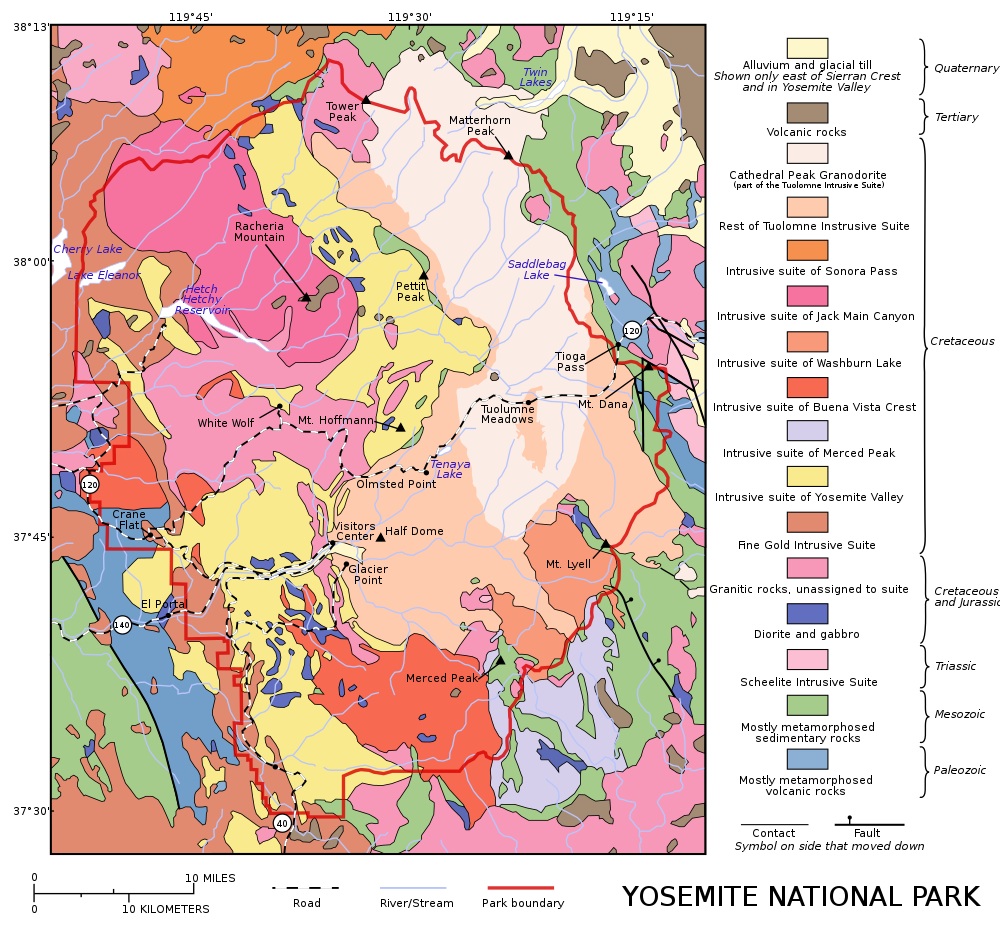
A geological map of Yosemite National Park (full size), showing the Cathedral Peak Granodiorite, the largest unit in the Tuolumne Intrusive Suite, which in turn is the largest granitic suite in the park. Cathedral Peak Granodiorite Rest of the Tuolumne Intrusive Suite
The Lambert azimuthal equal-area projection is a projection used for mapping a sphere to a disk. It accurately represents area in all regions of the sphere, but it does not accurately represent angles. It is used in scientific disciplines such as geology for plotting the orientations of lines in three-dimensional space, and by the National Atlas of the US in its online map-making application.
This false-color mosaic showing compositional variations in the geology of the Moon was constructed from a series of 53 images taken through three spectral filters by the imaging system of the Galileo spacecraft. Bright pinkish areas are highlands materials, such as those surrounding the oval lava-filled Mare Crisiumimpact basin toward the bottom. Blue to orange shades indicate volcanic lava flows. To the left of Crisium, the dark blue Mare Tranquillitatis is richer in titanium than the green and orange maria above it. Thin mineral-rich soils associated with relatively recent impacts are represented by light blue colors. The monochrome band on the right edge shows the unretouched surface of the moon.


.svg)
.svg)


.jpg)


_-_Google_Art_Project.jpg)
 Vital article
.png)


 Featured biography


 Categories
 Curiosity is a car-sized rover designed to explore the crater Gale on Mars as part of NASA's Mars Science Laboratory mission. It was launched from Cape Canaveral in November 2011 and landed on Aeolis Palus inside Gale on August 6, 2012, at 05:17 UTC. Curiosity's landing site, nicknamed Bradbury Landing, was less than 2.4 km (1.5 mi) from the center of the rover's touchdown target after a 560-million km (350-million mi) journey. The rover's goals include an investigation of the Martian climate and geology; assessment of whether the selected field site inside Gale has ever offered environmental conditions favorable for microbial life, including investigation of the role of water; as well as planetary habitability studies in preparation for human exploration.
 Map: Grandiose, based on a map by the United States Geological SurveyA geological map of Yosemite National Park (full size), showing the Cathedral Peak Granodiorite, the largest unit in the Tuolumne Intrusive Suite, which in turn is the largest granitic suite in the park.
 Map: Strebe, using GeocartThe Lambert azimuthal equal-area projection is a projection used for mapping a sphere to a disk. It accurately represents area in all regions of the sphere, but it does not accurately represent angles. It is used in scientific disciplines such as geology for plotting the orientations of lines in three-dimensional space, and by the National Atlas of the US in its online map-making application.
 Image credit: Galileo spacecraftThis false-color mosaic showing compositional variations in the geology of the Moon was constructed from a series of 53 images taken through three spectral filters by the imaging system of the Galileo spacecraft. Bright pinkish areas are highlands materials, such as those surrounding the oval lava-filled Mare Crisium impact basin toward the bottom. Blue to orange shades indicate volcanic lava flows. To the left of Crisium, the dark blue Mare Tranquillitatis is richer in titanium than the green and orange maria above it. Thin mineral-rich soils associated with relatively recent impacts are represented by light blue colors. The monochrome band on the right edge shows the unretouched surface of the moon.
 Cartographic relief depiction showing the varying age of bedrock underlying North America. This image combines a geologic map and a shaded relief image. This combination reveals the geologic history of North America through the interrelation of rock type, topography and time. Regional surface processes as well as continent-scale tectonic events are exposed in the three dimensions of space and the fourth dimension, geologic time. From most recent to oldest, age is indicated by color: yellow, green, blue, red.


 Commons
 Wikidata
 Wikiquote
 Wikisource
 Wikiversity
 Wikivoyage
 Wiktionary